Tuesday, 13 September 2016

What you didn’t know about your brain?

We all know, that brain is one of the most important things that we have in our body. Without brain we won’t be able to breath and live. The brain is an organ that serves as the center of the nervous system in all vertebrate and most invertebrate animals. Only a few invertebrates such as sponges, jellyfish, adult sea squirts and starfish do not have a brain; diffuse or localized nerve nets are instead of brain.These are facts that are well known, but what about the tings that are not so well known?


These brain facts dispel many brain myths that linger from the past. Learn how the brain works, for better (or worse). All facts have original references.
The study of the human brain has been called the last frontier in science.
The field of neuroscience is still in its infancy, but is rapidly exploding — turning yesterday’s brain “facts” into today’s brain “myths.”
Experts agree there is more we don’t know about the brain than we currently know.


Human Brain Facts by the Numbers

The most complex entity known resides between your ears.
Here are some of the fascinating facts and figures about the human brain.
1. The typical brain is about 2% of a body’s weight but uses 20% of its total energy and oxygen intake.
2. Your brain is 73% water. It takes only 2% dehydration to affect your attention, memory and other cognitive skills.
3. Ninety minutes of sweating can temporarily shrink the brain as much as one year of aging.
4. Your brain weighs about 3 pounds. Of that, the dry weight is 60% fat, making your brain the fattiest organ.

5. Twenty-five percent of the body’s cholesterol resides within the brain. Cholesterol is an integral part of every brain cell. Without adequate cholesterol, brain cells die.
6. No one knows for sure, but the latest estimate is that our brains contain roughly 86 billion brain cells.
7. Each neuron connects with, on average, 40,000 synapses.
8. A piece of brain tissue the size of a grain of sand contains 100,000 neurons and 1 billion synapses all communicating with each other.



Wednesday, 24 August 2016

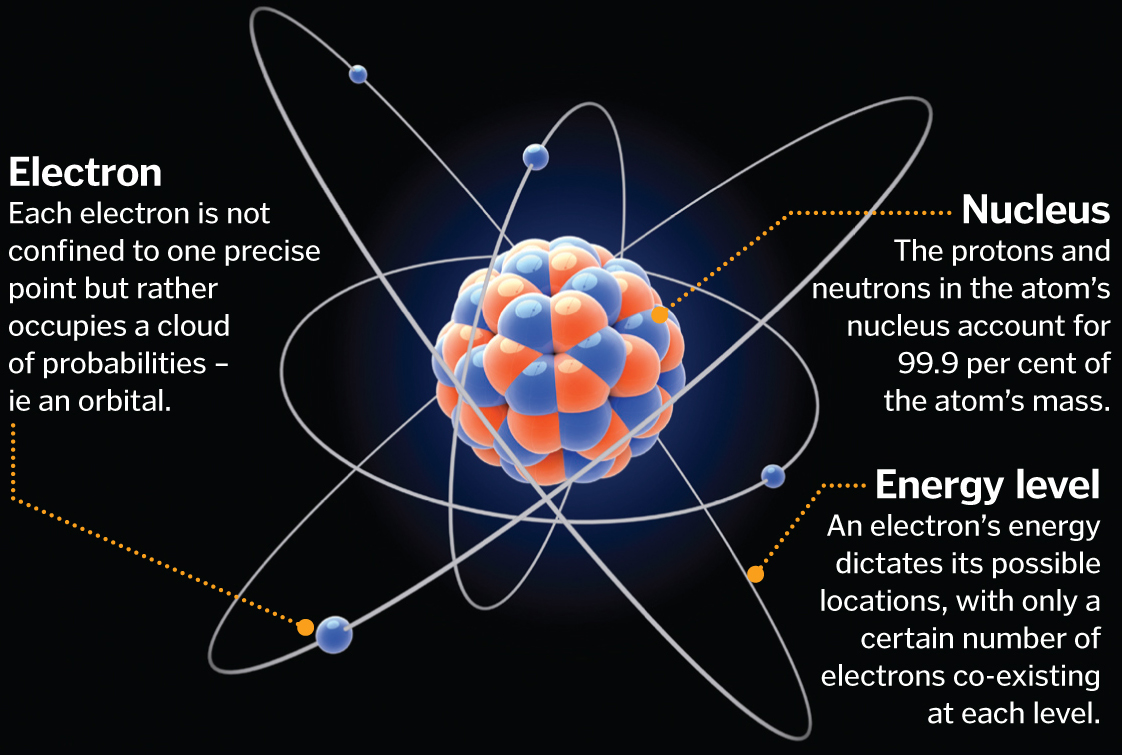
If you took out all the empty space in our atoms, the human race could fit in the volume of a sugar cube Atoms

The atoms that make up the world around us seem solid, but are in fact over 99.99999 per cent empty space. An atom consists of a tiny, dense nucleus surrounded by a cloud of electrons, spread over a proportionately vast area. This is because as well as being particles, electrons act like waves. Electrons can only exist where the crests and troughs of these waves add up correctly. And instead of existing in one point, each electron’s location is spread over a range of probabilities – an orbital. They thus occupy a huge amount of space.


A nucleon (proton or neutron) is about 1.5 femtometers across, which is 1.5x10⁻¹⁵ meters. So the number density of nuclear matter is about 0.1 nucleons per cubic fermi, or 0.1 fm-3. I don't have a source for these and I don't care to google it; these are just the numbers I have at my finger tips for my research, but if you'd like to know more you can google the "nuclear saturation density."
Anyway, if the average person has a mass of about 60 kg, and that mass is 99.99% in the nucleons, then we can just take the number of humans in the world times their mass, divide by the nuclear mass density (which is the number density times the mass of a nucleon).


A nucleon (proton or neutron) is about 1.5 femtometers across, which is 1.5x10⁻¹⁵ meters. So the number density of nuclear matter is about 0.1 nucleons per cubic Fermi, or 0.1 fm-3. I don't have a source for these and I don't care to google it; these are just the numbers I have at my finger tips for my research, but if you'd like to know more you can google the "nuclear saturation density."
Anyway, if the average person has a mass of about 60 kg, and that mass is 99.99% in the nucleons, then we can just take the number of humans in the world times their mass, divide by the nuclear mass density (which is the number density times the mass of a nucleon).

Thursday, 28 July 2016

Scientists have developed a way of charging mobile phones using urine

Yes; Soon Mobile phone owners could be able to charge their batteries with their own urine.
Scientists working at the Bristol Robotics Laboratory have described the “breakthrough” finding of charging cell phones using urine as the power source to generate electricity.


Urine_powered_mobi_2619303b    image source : (www.telegraph.co.uk)

Dr Ioannis Ieropoulos, an expert at harnessing power from unusual sources using microbial fuel cells at the University of West England, Bristol, which was also involved in the research, said the urine-powered phone is a ‘world first’.
‘No-one has harnessed power from urine so it’s an exciting discovery.

A fuel cell which can use the energy from your URINE to power a mobile phone could mean a future of cheap energy.
The miniature invention which costs just £2 has the capability to generate electricity - meaning a single visit to the toilet has been used to recharge a smartphone for the first time.
Scientists have been able to provide three hours of phone calls for every six hours of charge time - all from 600ml of urine.
The microbial fuel cell technology provides enormous potential to enable people to stay connected in areas that are off grid using "pee power".

The world first has been developed at the University of the West of England in Bristol by Professor Ioannis Ieropoulos and his team.
Professor Ieropoulos said: "We are excited to announce several global firsts - this development was possible by employing a new design of microbial fuel cells that allowed scaling up without power density losses.


  Man taking a picture of with smartphone

 Several energy-harvesting systems have been tested and results have demonstrated that the charging circuitry of commercially available phones may consume up to 38% of energy on top of the battery capacity.

Sunday, 24 July 2016

One Million Earths Can Fit Inside The Sun


Ancient astronomers once believed the Earth was at the centre of the Universe but now we know that the Sun is at the centre of our Solar System and our planets orbit the Sun. The Sun makes up 99.8% of the entire mass of the whole Solar System. One million Earths would be needed to be the same size as the Sun.

The visible part of the sun is about 10,000 degrees Fahrenheit (5,500 degrees Celsius), while temperatures in the core reach more than 27 million F (15 million C), driven by nuclear reactions. One would need to explode 100 billion tons of dynamite every second to match the energy produced by the sun, according to NASA.
The sun is one of more than 100 billion stars in the Milky Way. It orbits some 25,000 light-years from the galactic core, completing a revolution once every 250 million years or so. The sun is relatively young, part of a generation of stars known as Population I, which are relatively rich in elements heavier than helium. An older generation of stars is called Population II, and an earlier generation of Population III may have existed, although no members of this generation are known yet.

Scientists Release Audio Of Gargantuan Black Hole Collision


Approximately 1.4 billion years ago, two gargantuan black holes — one 14 times as large as the Sun, the other eight times as large — collided. This caused them to merge, creating an even larger black hole 21 times as large as the Sun that then released a wave of gravitational energy as massive as one Sun.
Now, all these millennia later, that enormous amount of energy, in the form of gravitational waves, finally arrived at Earth and tripped the LIGO( Laser Interferometer Gravitational ) detectors.

That said, what you’re hearing above is the scientists’ audio representation of the event, not an actual “field recording.” When LIGO’s detectors capture gravitational waves, they’re not collecting audio data, but data about ripples in space-time that can be represented by audio perceptible to the human ear.
And that audio probably doesn’t sound like you’d think it would. The adjusted sound is something of a dull bloop, and the pitch-adjusted sound is more like a smooth whistle.
In addition to those sounds of the gravitational waves from the newly announced black hole collision (first detected last December), you’ll hear the audio of LIGO’s historic first detection of gravitational waves back in September.

That first detection marked a monumental moment in science, proving the very existence of gravitational waves — ripples in space time caused by extraordinary events — and confirming Albert Einstein’s theories about general relativity made over 100 years ago.
Now, with this second detection of gravitational waves under their belts, LIGO scientists plan to continue searching for gravitational waves and, in the words of LIGO deputy director Albert Lazzarini, unlock the secrets of “the darkest yet most energetic events in our universe.”